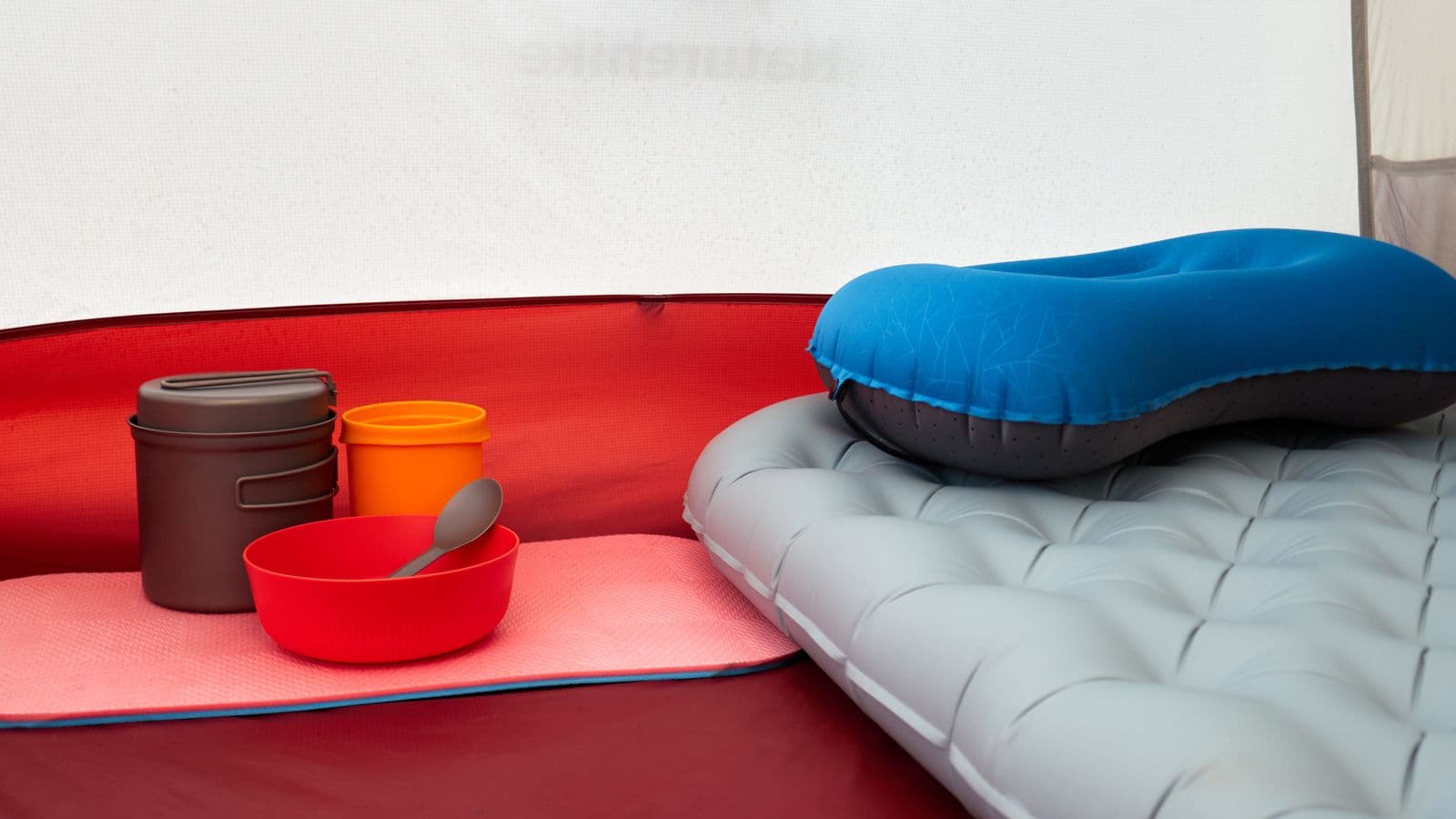
For most camping (three-season, lows around freezing), look for a sleeping pad with an R-value of 3 to 4.5. Summer-only camping needs just R 1–2; winter below ~20°F wants R 5+, and deep winter R 6–7. R-values add up when you stack pads, and cold sleepers should round up by about +1. When in doubt, go warmer — you can't have too much.
R-value measures how well a sleeping pad stops the cold ground from stealing your body heat — the higher the number, the warmer the pad. It matters more than people expect: you crush your sleeping bag's insulation flat underneath you, so the pad is your real defense against the cold ground. Here's how much you need. New to pads? See air vs foam pads and our pad picks.
R-value calculator: what do you need?
Set the coldest night you expect and how you sleep, and you'll get a recommended minimum R-value. It uses the same guidelines as the chart below, with a little added for cold sleepers and cold surfaces.
Three-season
Look for a pad rated R 3.5 or higher. A higher R-value is never too warm, so round up if in doubt.
See pads rated R 3.5+ →A guide based on widely used R-value/temperature guidelines (ASTM F3340) — not lab testing. Match the pad to the coldest nights you actually expect.
R-value by season & temperature
Match the pad to the coldest nights you expect. These are widely used guidelines — round up if you sleep cold.
| Conditions | Low temps | R-value to look for |
|---|---|---|
| Summer only | 50°F+ / 10°C+ | R 1–2 |
| Three-season (most camping) | ~30°F / 0°C | R 3–4.5 |
| Cold three-season / shoulder | ~20°F / -7°C | R 4.5–5 |
| Winter | ~10°F / -12°C | R 5–6 |
| Deep winter | 0°F / -18°C | R 6–7 |
| Extreme / expedition | -10°F / -23°C or lower | R 7.5+ |
One pad for most of the year: a single R 4–4.5 pad covers everything from summer to light frost, which is why it's the most popular all-round choice. Only dedicated winter campers need to go higher.
How R-value is measured
Since 2020, most brands test sleeping pads to the same ASTM F3340 standard: the pad is placed between a warm plate (about body temperature) and a cold plate, and sensors measure how much heat passes through. Because it's standardized, an R-4 pad from one brand is genuinely comparable to an R-4 from another — so you can trust the number when you shop.
The stacking trick
R-values are additive, which is the cheapest way to handle cold trips: lay a closed-cell foam pad (about R-2) under your air pad (say R-3) and you get roughly R-5 — winter-ready — while the foam also shields the air pad from sharp ground. It's more flexible than buying a single ultra-warm pad, and the foam pad earns its place as a sit pad and backup the rest of the year. More on the two pad types in air vs foam sleeping pads.
Who needs more
The chart is a starting point, not a rule. Cold sleepers and many women are more comfortable adding about +1 to the R-value for a given temperature. Sleeping straight on snow, on a cot in cold air, or in a hammock (where cold hits you from below) also calls for more insulation than the same night on warm summer ground. When unsure, round up — the warmth is rarely wasted.
FAQ
What R-value do I need for a sleeping pad?
For most camping (three-season, lows around freezing) aim for an R-value of 3 to 4.5. Summer-only camping needs just R 1–2, while winter camping below about 20°F wants R 5 or more, and deep winter R 6–7. When in doubt, size up — a higher R-value pad is never too warm, but too little insulation means a cold night.
What does R-value mean on a sleeping pad?
R-value measures a sleeping pad's resistance to heat loss — how well it stops the cold ground from drawing warmth out of your body. The higher the number, the warmer the pad. Since 2020, most brands test to the same ASTM F3340 standard, so R-values are now directly comparable across manufacturers.
Is R-value or my sleeping bag more important for warmth?
Both matter, and they work together. Your sleeping bag traps warm air around you, but you crush the insulation underneath your body flat, so the pad's R-value is what stops the ground from stealing your heat. A warm bag on a low-R pad still sleeps cold — match the pad to the conditions, not just the bag.
Can you have too high an R-value?
Not really — a high R-value pad won't make you too hot, because it only resists heat loss to the ground rather than adding warmth. The only downsides of a very warm pad are usually a bit more weight, bulk, and cost. That's why a single warm three-to-four-season pad is a sensible year-round choice for many campers.
Do R-values add up if you stack pads?
Yes — R-values are additive, so stacking pads combines their warmth. A foam pad rated R-2 under an air pad rated R-3 gives you about R-5, enough for winter. It's a cheap, flexible way to add warmth for cold trips without buying a dedicated winter pad, and the foam protects the air pad too.
Do women and cold sleepers need a higher R-value?
Often, yes. Many women and anyone who tends to sleep cold are more comfortable adding about +1 to the R-value they'd otherwise choose for the temperature. It's a small change that makes a real difference on cold nights — when unsure, round up.
What R-value is good for winter camping?
For winter nights around 20°F, look for at least R 5; for colder conditions down toward 0°F, aim for R 6–7; and for extreme expedition cold below -10°F, R 7.5 or higher. Many winter campers reach those numbers by stacking a foam pad under an insulated air pad rather than buying one ultra-high-R pad.
Ready to choose? See our best sleeping pad picks, compare air vs foam, and match it with the right sleeping bag.