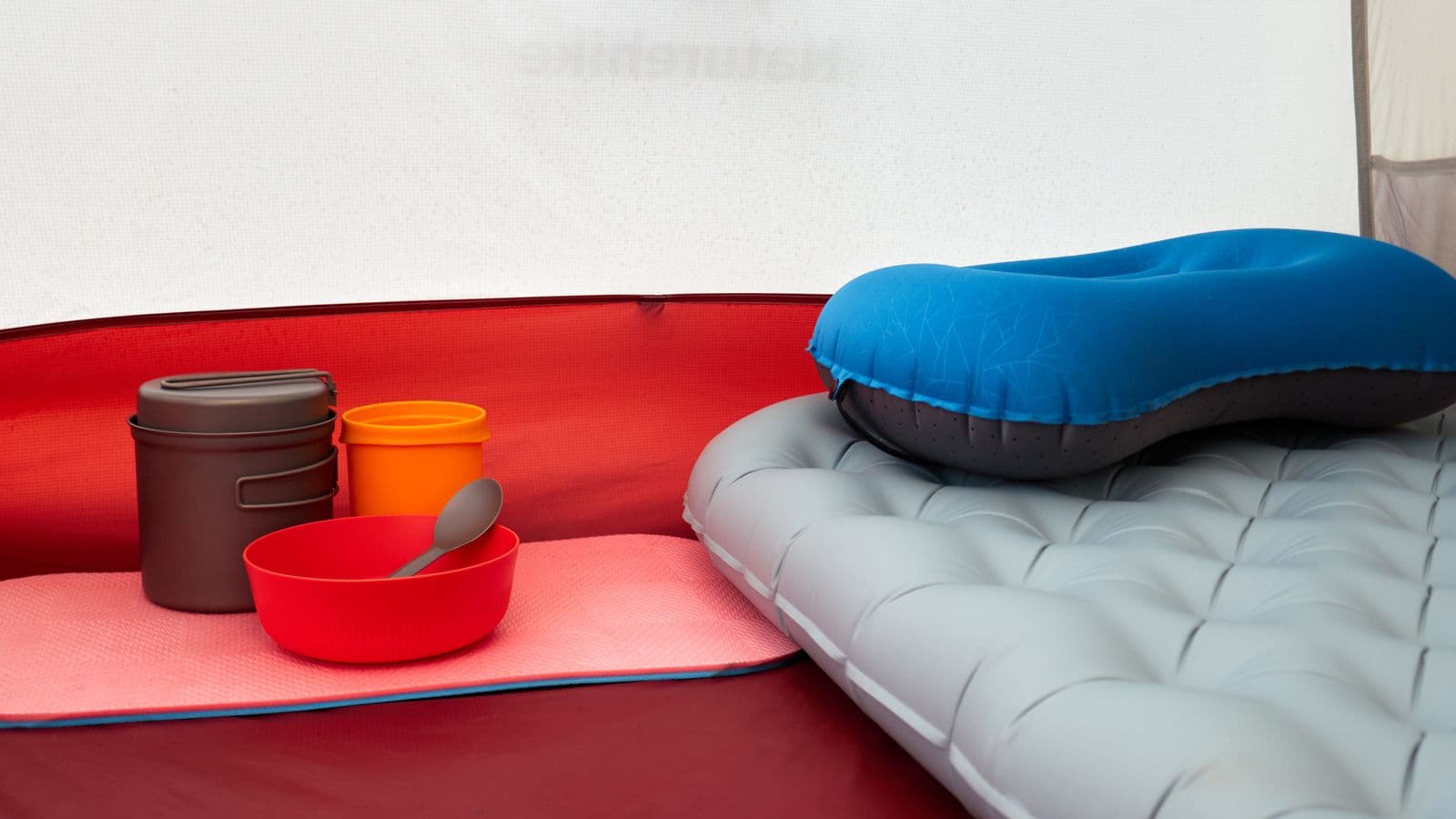
Choose an air pad for comfort, small packed size, and cold-weather warmth — it's thicker and warmer but costs more and can puncture. Choose a closed-cell foam pad for budget, near-indestructible durability, and zero fuss — it's cheap and never goes flat, but thin, firm, and bulky. Most campers are happiest on an air pad; many backpackers carry a foam pad too, for durability or as a backup.
Your sleeping pad does two jobs: cushioning you from the ground and — just as important — insulating you from it, since cold seeps up by conduction all night. The first decision is the pad's construction: an inflatable air pad or a roll-up closed-cell foam pad (with self-inflating pads as a middle ground). New to sleep systems? See our best sleeping pad picks, and pair this with down vs synthetic bags.
Air vs foam, side by side
The trade-off in one table. “Best for” is the headline; the rest is why.
| Factor | Air pad | Foam pad |
|---|---|---|
| Comfort | Thick and cushioned | Thin and firm |
| Packed size | Packs very small | Bulky — straps outside the pack |
| Weight | Light (insulated ones a bit more) | Very light |
| Warmth (R-value) | Wide range, up to winter-ready | Modest, fixed (~2) |
| Durability | Can puncture — needs a repair kit | Almost indestructible |
| Setup | Inflate by mouth or pump | Unroll and go |
| Price | $$–$$$ | $ |
| Best for | Comfort, packability, cold trips | Budget, durability, rough ground, a backup |
Air pads
An air pad inflates to a thick, cushioned mattress that packs down to the size of a water bottle — the best comfort-to-packed-size ratio you can buy. Insulated versions add reflective film or synthetic fill inside for genuine cold-weather warmth, with R-values reaching well into winter territory. The trade-offs: they cost more, you inflate them (a few breaths or a pump sack), and a sharp object can puncture them — so they come with a patch kit.
- Most comfortable — thick and cushioned
- Packs very small and light
- Available in warm, winter-ready R-values
- Can puncture (carry the repair kit)
- More expensive
- Has to be inflated
Best for: comfort-seekers, backpackers counting packed size, and anyone camping in the cold.
Closed-cell foam pads
A foam pad is a simple roll (or accordion fold) of dense closed-cell foam. It's cheap, weighs almost nothing, never punctures or goes flat, and doubles as a sit pad or groundsheet. The catch is comfort and bulk: it's thin and firm, its warmth is fixed at a modest R-value of about 2, and it's too bulky to pack inside — it straps to the outside of a pack.
- Cheapest and most durable — can't puncture
- Never goes flat; zero setup
- Very light; doubles as a sit pad/backup
- Thin and firm — least comfortable
- Bulky — straps outside the pack
- Modest, fixed warmth (~R-2)
Best for: tight budgets, rough or unknown ground, ultralight minimalists, and as a backup or stacking layer.
The cold-weather trick: R-values add up, so stacking a foam pad under an air pad combines their warmth (e.g. R-2 foam + R-3 air ≈ R-5, winter-ready) — and the foam protects the air pad from the ground. More on matching warmth to conditions in what R-value do I need.
Air pad vs self-inflating pad: what's the difference?
An air pad is an empty chamber you inflate yourself; a self-inflating pad has open-cell foam bonded inside an airtight shell, so opening the valve lets the foam expand and draw air in on its own. That one construction difference drives everything else: the air pad is thicker, lighter, and packs far smaller; the self-inflating pad is firmer, more puncture-tolerant (the foam still insulates even if it leaks), and near-zero effort — but heavier and bulkier rolled up.
And are foam mats better than self-inflating pads? Only on price, weight, and indestructibility. A closed-cell foam mat can't fail and costs the least, but it's thin, firm, and stuck at roughly R-2; a self-inflating pad is noticeably more comfortable and warmer for a modest cost step. All three, side by side:
| Factor | Air pad | Self-inflating | Foam mat |
|---|---|---|---|
| Thickness / comfort | 2–4 in, most cushioned | 1–3 in, firmer | ~0.5–0.75 in, firm |
| Warmth (R-value) | Wide range, up to winter | Mid, solid 3-season | Fixed, ~2 |
| Packed size & weight | Smallest, light | Bulkier, heaviest | Very light, bulkiest |
| If punctured | Goes flat — patch it | Softens, foam still insulates | Can't puncture |
| Best for | Backpacking, cold trips | Car camping comfort | Budget, backup, rough ground |
For car camping, where weight doesn't matter, the self-inflating pad is often the sweet spot: comfort close to an air pad, foam-like reliability, zero fuss.
So, which should you choose?
Ask how you camp. Want the best comfort and warmth, or carrying it far? An air pad wins. On a budget, hard on gear, or want a zero-worry backup? A foam pad earns its place. Car camping and after maximum comfort? Consider a self-inflating pad or a thicker camping mattress (see air mattress vs sleeping pad). Whichever you pick, get the right R-value for your conditions — it matters more than the pad type — and see our pad picks.
FAQ
Are air or foam sleeping pads better?
It depends on what you value. Air pads are far more comfortable, pack much smaller, and come in warm, winter-ready versions — but they cost more and can puncture. Closed-cell foam pads are cheap, nearly indestructible, and never go flat, but they're thin, firm, and bulky. Most campers prefer an air pad for comfort; many backpackers carry a foam pad for durability or as a backup.
Do foam sleeping pads keep you warm?
Somewhat — closed-cell foam has a fixed R-value of roughly 2, which is fine for summer and mild three-season nights but not for cold weather. Because R-values add together, a popular cold-weather trick is to stack a foam pad under an air pad: an R-2 foam plus an R-3 air pad gives you about R-5, enough for winter.
Do air sleeping pads puncture easily?
Not easily, but it can happen — a sharp stick or thorn through the floor is the usual culprit. Clear the ground before pitching, use a groundsheet, and carry the patch kit that comes with most pads. Closed-cell foam can't puncture at all, which is exactly why some campers keep one as a no-worries backup.
What is a self-inflating sleeping pad?
A self-inflating pad is the middle ground: open-cell foam inside an airtight shell that draws in air when you open the valve, then you top it off by mouth. They're more comfortable and warmer than plain foam, more durable and fuss-free than a pure air pad, but heavier and bulkier than both — a great car-camping choice.
What is the difference between an air pad and a self-inflating pad?
An air pad is an empty inflatable chamber — you (or a pump sack) provide all the air, which makes it thicker, lighter, and smaller-packing. A self-inflating pad has open-cell foam inside that expands and draws air in on its own when the valve opens. The self-inflating pad is firmer, lower-effort, and keeps insulating even with a slow leak, but it's heavier and bulkier packed.
Are foam mats better than self-inflating pads?
Foam mats win on price, weight, and durability — they can't puncture or go flat, ever. Self-inflating pads win on comfort and warmth: thicker cushioning and a higher R-value for only moderately more money. For rough ground, backup use, or the lowest budget, take the foam mat; for a comfortable night car camping, the self-inflating pad is better.
Which sleeping pad is best for backpacking?
Usually an insulated air pad — it gives the best comfort and warmth for the lowest packed size and weight, which is what matters when you carry it. Many backpackers still bring a thin foam pad too: as a durable sit pad, a groundsheet, or a backup if the air pad fails on a long trip.
How much should a sleeping pad cost?
Closed-cell foam pads are cheap, often $15–45. Quality insulated air pads run roughly $60–200 depending on warmth and weight, and self-inflating pads sit in between. As with sleeping bags, spending on the right R-value for your conditions matters more than chasing the lowest price.